Built for trust.
Controls, auditability, and documentation for every financial workflow.
PayDoc is designed to preserve source artifacts, workflow history, approvals, reconciliation status, and GL impact across payer and patient payment operations — so every cent is explainable.
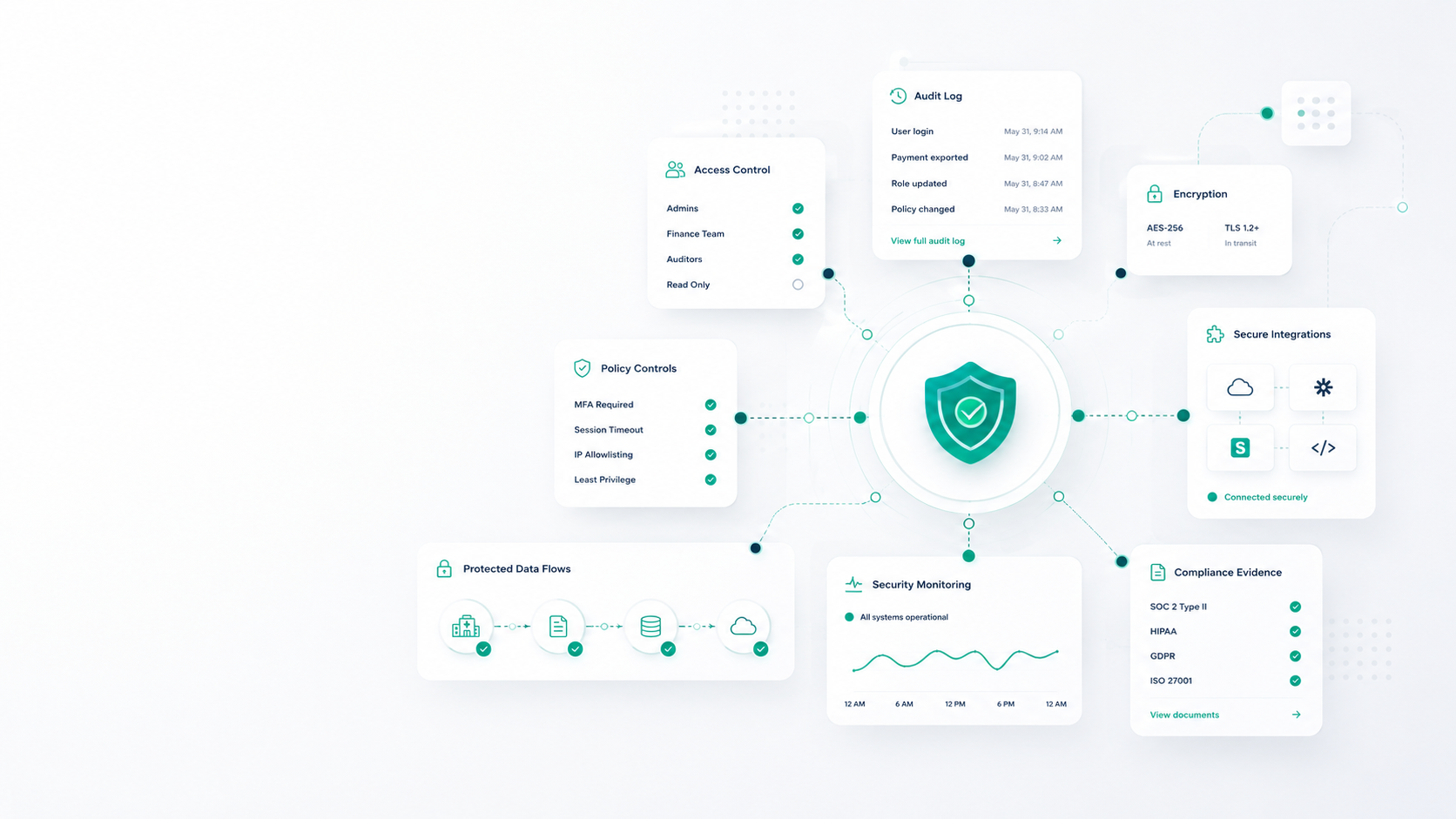
Audit trail
Every event. Every actor. Every outcome.
PayDoc records every financial event as an immutable entry. Nothing is overwritten. Nothing disappears. If a cent moved, the record exists.
Source artifact preservation
Every 837, 835, 999, 277CA, lockbox file, and payment record is stored and linkable from any downstream workflow step — from claim to GL entry.
Actor tracking on every event
Every financial event records the actor — system, user identity, or agent key. Who approved a write-off? Which agent recommended the appeal? The record says.
Immutable MoneyEvent ledger
Every financial movement produces a MoneyEvent record. Events are append-only. The cent lifecycle is permanently traceable from Expected to PostedToGL.
Compliance workspace
Evidence, documentation, and workflow approval — all in one place.
The PayDoc compliance workspace holds the source documents, the workflow approvals, and the reconciliation status for every period — ready for internal or external audit.
Access and isolation
Tenant isolation and role-based access control.
PayDoc is a multi-tenant platform. Every record, every report, and every API response is tenant-scoped. Cross-tenant data access is architecturally prevented, not just policy-prevented.
Hard tenant isolation
TenantId is required on every service call, enforced at the repository layer. No query runs without tenant scoping.
Role-based access
Billing staff, managed service operators, finance reviewers, and compliance officers operate on distinct permission sets. Sensitive GL and audit functions require elevated roles.
PHI-free event bus
PayDoc's event contracts carry identifiers and metadata only — no patient names, MRNs, or clinical text in event payloads. PHI stays in the source record, not the event spine.
AI agent governance
AI agents that recommend. Humans that approve.
PayDoc's AI agents operate under a strict governance model. They classify, explain, draft, and prioritize. They never execute money movement, write-offs, refunds, or GL finalization without explicit human approval.
Common questions
Security and compliance FAQ.
Is PayDoc HIPAA compliant?
PayDoc is designed to operate within HIPAA-covered healthcare payment workflows. We implement the technical, administrative, and physical safeguards required for covered entities and business associates. PHI handling practices and BAA availability can be reviewed during the sales engagement.
How are source artifacts stored and protected?
All source artifacts (837s, 835s, 999s, 277CAs, lockbox files, payment receipts) are stored with tenant isolation and linked to the financial records that reference them. Retention policies are tenant-configurable within platform minimums. Access is audit-logged.
Can AI agents move money or finalize accounting entries without human approval?
No. PayDoc's AI governance model explicitly prohibits agents from executing money movement, write-offs, refunds, or GL finalization without explicit human approval. Agents classify, recommend, and draft — humans approve and execute.
How is data isolated between tenants?
TenantId is enforced at the service and repository layer on every operation. Cross-tenant data access is architecturally prevented. Managed service operators work inside their assigned tenant's scope only.
What certifications does PayDoc hold?
PayDoc is designed to support HIPAA-covered workflows and implements controls aligned with healthcare data security standards. We will publish formal certifications and attestations as they are completed. Contact us for the current compliance posture document.
Every cent explainable. Every workflow auditable.
Talk to us about your compliance requirements. We'll walk through the audit trail, the access controls, and the agent governance model with your team.